Biomechanics Lab (BML)
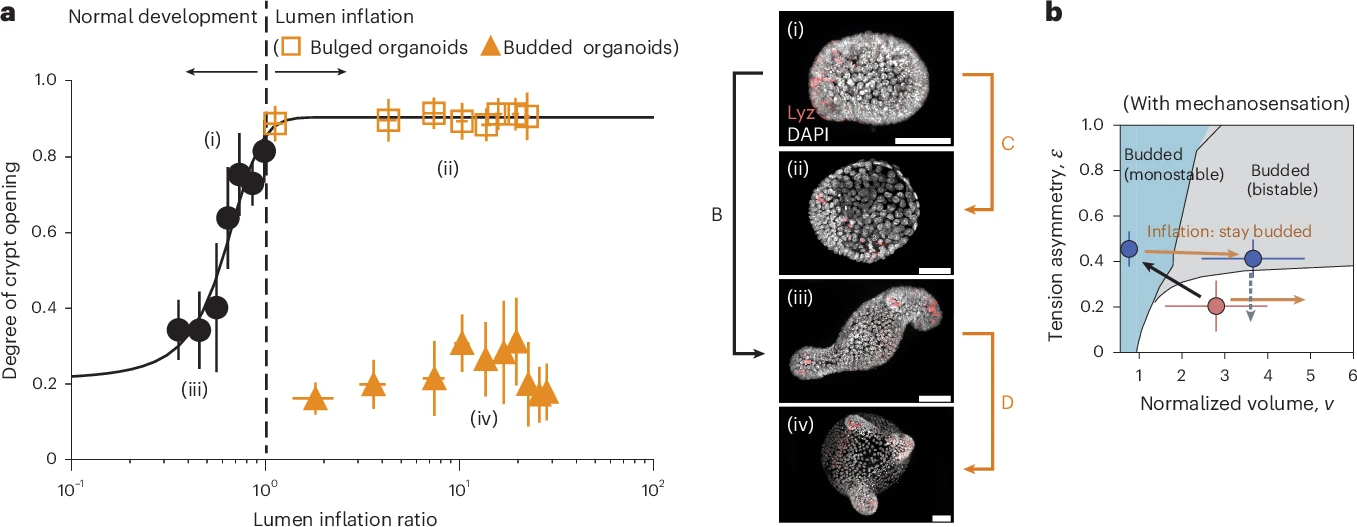
Our laboratory deciphers the “mechanical code” governing tissue morphology and cell fate through mechano-chemo-biological coupling. Across scales, from cells to tissues and from development to disease, we have identified “cell cluster mechanical synergy”, revealed how tension and hydraulic pressure coordinate intestinal organoid morphogenesis and homeostasis, and developed a framework for tumor mechanical adaptation and vascular instability.
Currently, we focus on the dynamics of active cell clusters, moving the field from qualitative description toward quantitative prediction. Our two major research directions are:
Cell self-assembly and tissue morphogenesis. We investigate how cell self-assembly, tissue morphogenesis, and collective cell migration are regulated by mechanical interactions among pathogens, tumors, and host tissues, to uncover the mechanobiological principles underlying embryonic development, inflammatory responses, and cancer invasion.
Modeling collective cell dynamics. We develop theoretical models and numerical methods from solid mechanics, fluid mechanics, and soft-matter physics to quantitatively simulate and predict collective cell migration, tissue deformation, and remodeling.
Morphogenesis of biological tissues
- Mechanochemical coupling
- Stress-modulated growth and remodeling
- Nematic order and topological defects
Pattern formation of soft materials
- Elastic instability
- Phase transition
- Multi-physical coupling mechanisms